The role of artificial intelligence in retail stores has evolved from a futuristic concept to an essential business strategy. AI use cases in retail industry span across customer experience, inventory management, pricing optimization, and operational efficiency. Modern retailers leveraging AI technologies are witnessing unprecedented growth in customer satisfaction, revenue generation, and competitive advantage. Understanding how retailers benefit from AI adoption is crucial for businesses seeking to thrive in today's digital marketplace.
Personalized Customer Experience and Recommendation Systems
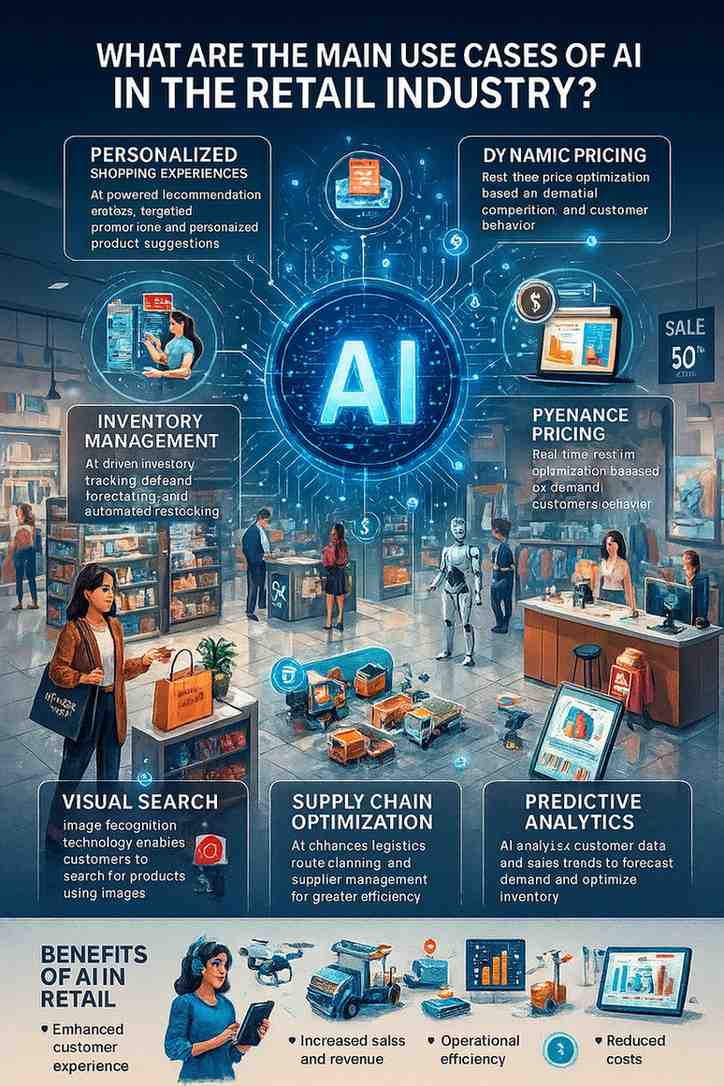
How does AI improve customer experience in retail? AI-powered recommendation engines analyze customer behavior, purchase history, and browsing patterns to deliver hyper-personalized shopping experiences. These systems process millions of data points to suggest relevant products, increasing conversion rates by up to 35%.
Machine learning algorithms enable retailers to:
Create dynamic product recommendations based on real-time customer interactions
Personalize website layouts and content for individual shoppers
Optimize email marketing campaigns with targeted product suggestions
Enhance cross-selling and upselling opportunities through intelligent product bundling
Benefits of artificial intelligence in retail industry include improved customer loyalty, higher average order values, and reduced cart abandonment rates. Major retailers report significant revenue increases after implementing AI-driven personalization strategies.
AI Chatbots and Customer Service Automation
Benefits of using AI chatbots in retail customer service extend beyond cost reduction to encompass 24/7 customer support, instant query resolution, and multilingual assistance. Modern AI chatbots handle complex customer inquiries, process returns, track orders, and provide product information with human-like conversational abilities.
Key advantages include:
Immediate response to customer queries regardless of time zones
Consistent service quality across all customer touchpoints
Seamless escalation to human agents when necessary
Integration with inventory systems for real-time product availability updates
Advanced natural language processing enables chatbots to understand context, sentiment, and intent, creating more meaningful customer interactions.
Predictive Analytics and Inventory Management
Predictive analytics in retail using AI transforms inventory management from reactive to proactive. AI algorithms analyze seasonal trends, market conditions, customer demand patterns, and external factors to forecast inventory requirements with remarkable accuracy.
AI-powered inventory optimization delivers:
Reduced stockouts and overstock situations
Optimized warehouse space utilization
Improved cash flow through better inventory turnover
Enhanced supplier relationship management through accurate demand forecasting
Machine learning models continuously learn from new data, refining predictions and adapting to changing market conditions. This results in inventory accuracy improvements of up to 50% compared to traditional forecasting methods.
Dynamic Pricing and Revenue Optimization
AI enables retailers to implement sophisticated dynamic pricing strategies that respond to market conditions in real-time. Intelligent pricing algorithms consider competitor prices, demand fluctuations, inventory levels, customer segments, and market trends to optimize pricing decisions.
Dynamic pricing benefits include:
Maximized profit margins through optimal price points
Competitive advantage through real-time price adjustments
Improved inventory turnover through strategic markdowns
Enhanced customer segmentation for targeted pricing strategies
Retailers using AI-driven pricing strategies report revenue increases of 2-8% while maintaining customer satisfaction levels.
Computer Vision and Visual Search
AI-powered visual search technology allows customers to search for products using images instead of text. Computer vision algorithms analyze visual elements like colors, patterns, shapes, and textures to identify similar products in the retailer's catalog.
Visual search applications include:
Image-based product discovery and recommendations
Virtual try-on experiences for fashion and beauty products
Automated product tagging and categorization
Quality control and defect detection in manufacturing
This technology particularly benefits fashion, home décor, and beauty retailers where visual appeal drives purchasing decisions.
Supply Chain Optimization and Logistics
AI transforms supply chain management through intelligent route optimization, demand forecasting, and logistics coordination. Machine learning algorithms analyze traffic patterns, weather conditions, delivery constraints, and customer preferences to optimize delivery routes and schedules.
Supply chain AI applications include:
Automated warehouse operations with robotics integration
Predictive maintenance for equipment and machinery
Supplier performance monitoring and risk assessment
Last-mile delivery optimization for improved customer satisfaction
These innovations result in reduced operational costs, faster delivery times, and improved supply chain resilience.
Fraud Detection and Security Enhancement
AI-powered fraud detection systems analyze transaction patterns, customer behavior, and payment data to identify suspicious activities in real-time. Machine learning models detect anomalies that might indicate fraudulent transactions, protecting both retailers and customers.
Security benefits include:
Real-time fraud prevention with minimal false positives
Enhanced payment security through behavioral biometrics
Automated risk scoring for transactions and customers
Compliance with data protection regulations
Advanced AI systems can detect new fraud patterns as they emerge, continuously improving security measures.
Generative AI in Retail Marketing
Generative AI in retail marketing revolutionizes content creation, advertising campaigns, and customer communication. AI systems generate product descriptions, marketing copy, social media content, and personalized email campaigns at scale.
Generative AI applications include:
Automated product catalog descriptions and specifications
Personalized marketing content for different customer segments
Dynamic advertising creative optimization
Social media content generation and scheduling
This technology enables retailers to maintain consistent brand messaging while personalizing communications for individual customers.

Future of AI in the Retail and E-commerce Sector
Future of AI in the retail and e-commerce sector promises even more sophisticated applications including augmented reality shopping experiences, voice commerce optimization, and predictive customer lifetime value modeling. Emerging technologies like quantum computing and advanced neural networks will further enhance AI capabilities in retail.
Professional AI Retail Development Services
For retailers seeking to implement AI solutions, partnering with experienced developers is crucial. AI Retail app development company in Dallas, USA offers comprehensive services including custom AI integration, mobile app development, and ongoing optimization.
iOS AI Retail development services and Android AI Retail development services provide platform-specific solutions optimized for mobile commerce. When you hire Retail AI developers in Dallas, USA, you gain access to expertise in machine learning, data analytics, and retail technology integration.
Conclusion
Role of AI in retail customer experience optimization continues expanding as technology advances and consumer expectations evolve. Retailers investing in AI technologies today position themselves for sustained competitive advantage and growth. The comprehensive benefits of artificial intelligence in retail industry make AI adoption not just advantageous but essential for future success.
Whether implementing chatbots, predictive analytics, or personalization engines, AI transforms every aspect of retail operations. The question is no longer whether to adopt AI, but how quickly retailers can implement these transformative technologies to enhance customer experiences and drive business growth. To accelerate this journey, businesses can hire Retail AI developers in Dallas, USA, who specialize in building intelligent retail solutions that improve personalization, streamline operations, and deliver measurable ROI.
- #use-cases-of-ai-in-the-retail
- #ai-in-the-retail
- #ai-in-retail-industry
- #ai-in-retail
- #ai-in-retail-market
- #ai-in-retail-market-share
- #ai-in-retail-market-size
- #ai
- #retail-industries-technology-solutions
- #hyenaappdevelopment
- #app-development
- #e-commerce-and-retail-app-development-company
- #retail-app-development
- #retail-mobile-app-development-company
- #android-app-development
About the author
Hyena Information Technologies, founded in 1999, specializes in software development and consulting, focusing on mobile applications, AI, and IoT solutions for diverse clients.
Comments
Join the discussionNo comments yet. Be the first to comment.
